5 Jewelry Customer Questions You Can Answer Faster
Turn repetitive jewelry inquiries into useful conversations with approved answers, clear handoff rules, and a practical first test.
“What’s the price?” “What material is it?” “Can it be customized?” Jewelry businesses can answer these questions faster with an AI assistant using approved product details, policies, and clear handoff rules. Keep quotes, uncertain facts, and exceptions with your team.
What does the price include?
Give shoppers the price, currency, included items, and extra charges. Supply separate costs for chains, engraving, or shipping so the assistant can explain the total accurately. Send custom quotes and discount requests to your team; guide the shopper toward the right product or a confirmed quote.
An approved answer might say, “The pendant price excludes the chain.” CatchGrow’s knowledge guide recommends concrete pricing and escalation rules (CatchGrow, checked November 2026).
What material is the jewelry made of?
Provide metal composition, fineness, stone details, measurements, and care instructions. The assistant can explain documented specifications and ask which detail matters most. Missing certifications, allergy questions, and specialist advice need a jeweler; offer the product specification or a conversation with your team as the next step.
For example, 18K gold contains 18 parts gold out of 24, according to the FTC’s jewelry guide (FTC, 2024). Never infer composition from a photo.
Can the piece be customized, and how long will it take?
Document approved engraving options, size ranges, design limits, and how estimates are confirmed. An assistant can describe those options and ask what the shopper wants changed. Your team should approve bespoke work, final quotes, and deadlines; invite the shopper to submit details or request a consultation.
Our practical rule: automate explanations before commitments. A saved production estimate is useful context, not a promise that a specific delivery date is achievable.
Can the customer return, exchange, or resize it?
Supply the actual policy: time limits, item condition, exclusions, resizing limits, charges, and process. The assistant can explain those rules and the next step, but a person should review exceptions, complaints, and unclear eligibility. Direct the shopper to a case review rather than promising a refund or alteration.
The FTC recommends getting refund and return policies in writing (FTC, 2024). Make personalized-item exclusions explicit.
Can the assistant help someone choose or book a consultation?
Provide product descriptions, consultation types, and useful preference questions about budget, style, or occasion. The assistant can narrow choices using supplied information; specialist recommendations go to your team. Offer a consultation request, or a confirmed booking when a suitable connected calendar and the required settings are available.
Google Calendar booking requires enabled booking, eligible sending, fresh availability, and customer confirmation; Draft-only mode does not create appointments (CatchGrow, checked November 2026).
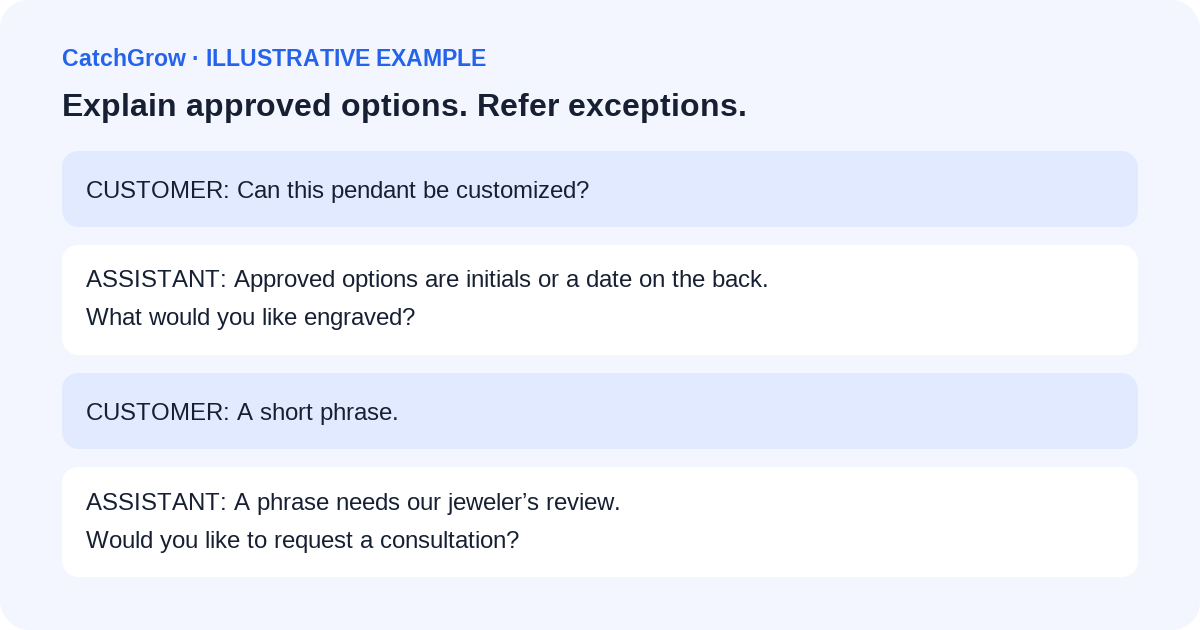
What could a customization conversation look like?
Illustrative example — fictional store options, not a real customer conversation.
Customer: Can this pendant be customized?
Assistant: Approved options are initials or a date on the back. What would you like engraved?
Customer: A short phrase.
Assistant: A phrase needs our jeweler’s review. Would you like to request a consultation?
How should you test your first approved answers?
- Review your last 20 customer conversations within your business.
- Identify the three most repeated questions.
- Write an approved answer for each, including handoff conditions.
- Choose the next step you want shoppers to take.
- Test those questions before enabling automated replies.
Start with one channel and one job. CatchGrow uses supplied business information to answer incoming inquiries and guide conversations toward your goal, with human takeover when needed.
Facebook Messenger, Instagram, WhatsApp, and website chat have documented connection paths, subject to permissions and setup (CatchGrow, channel guide, checked November 2026). Supported social channels do not require a website; uploaded product files are not live inventory.
Try it with your own customer questions.
Register, and the CatchGrow team will provide testing balance. Add your business information and check answer quality. Later, you can top up by credit card. Current inventory, custom quotes, delivery dates, and appointment availability require a suitable connected source or your team’s confirmation.
FAQ
How many karats?
Explain the product’s documented karat mark; the FTC describes it as the proportion of pure gold in a 24-part total. Do not guess from appearance.
Is it gold plated?
Use the product’s actual specification. The FTC distinguishes gold plating from other constructions; an assistant should not substitute a similar-sounding material description.
Is it too late to return for the correct size?
Check the store’s written policy and the item’s details. If timing or eligibility is uncertain, ask your team to review before approving an exchange.